Choosing the Right Paper Weight for Your Print Job
We see the same printing mistake happen every week. A business owner designs a stunning marketing piece, only to print it on a flimsy sheet that instantly cheapens their brand.
Choosing the Right Paper Weight for Your Print Job is often treated as an afterthought. Our expertise proves that material thickness heavily influences how an audience perceives a company. Picking too light means your brochure feels cheap.
Going too heavy causes the paper to crack at the folds.
We will explain exactly how the United States paper measurement system works. You will learn the exact specifications needed for different projects. This knowledge keeps your marketing costs down and your presentation quality high.
How Paper Weight Is Measured in the US
Our team frequently fields questions about the bizarre numbering system used for paper in the United States. Paper weight is officially measured in pounds (lb.), but that number does not refer to the weight of a single sheet. The weight actually represents 500 sheets of the paper’s uncut parent size.
We find this creates a confusing scenario where an 80 lb. text paper and an 80 lb. cover paper have vastly different thicknesses. “Text” and “cover” describe different parent sheet dimensions. A parent sheet of bond paper measures 17 by 22 inches.
Pro Tip: Always look at the category alongside the poundage. An 80 lb. cover stock will always be drastically thicker than an 80 lb. text stock because its starting parent sheet size was much smaller.
Our production specialists rely on these specific parent dimensions to calculate yield. Text paper parent sheets are much larger at 25 by 38 inches. Cover stock parent sheets measure 20 by 26 inches.
We recommend focusing on the category name alongside the number to avoid costly misprints. Commercial printers across the United States now reference grams per square meter (gsm) as a reliable international standard to clear up this confusion.
Our quick translation guide simplifies these common weights:
- 20 lb. bond / copy paper = approximately 75 gsm
- 60 lb. text = approximately 90 gsm
- 80 lb. text = approximately 120 gsm
- 80 lb. cover = approximately 216 gsm
- 100 lb. cover = approximately 270 gsm
Common Paper Types and Their Ideal Applications
Bond Papers for Everyday Office Use
We keep 20 lb. bond paper stocked in every standard office printer for a reason. This lightweight material is highly economical and perfectly functional for daily use. Drafts, internal memos, and temporary forms work best on this approximately 75 gsm stock.
Our designers avoid using 20 lb. bond for client-facing presentations because the thin material tears easily. Stepping up to a 24 lb. bond provides a subtle upgrade for corporate documents. The heavier weight visibly reduces “show-through” when printing on both sides. We recommend this option when contracts and multi-page reports need to look significantly cleaner.
Text Papers for Marketing and Sales
Our production managers consider 60 lb. text the entry point for professional marketing materials. This 90 gsm paper holds color remarkably well and feels much less disposable than office copy paper. Folded brochures and booklet interiors perform beautifully on this weight without bulging at the seams.
We print standard corporate marketing flyers on 80 lb. text to strike a balance between quality and cost. This versatile material offers several distinct advantages for direct mailers:
- Accepts gloss and uncoated finishes flawlessly.
- Folds completely flat without requiring expensive pre-scoring.
- Maintains a substantial feel without triggering higher USPS postal weight penalties.
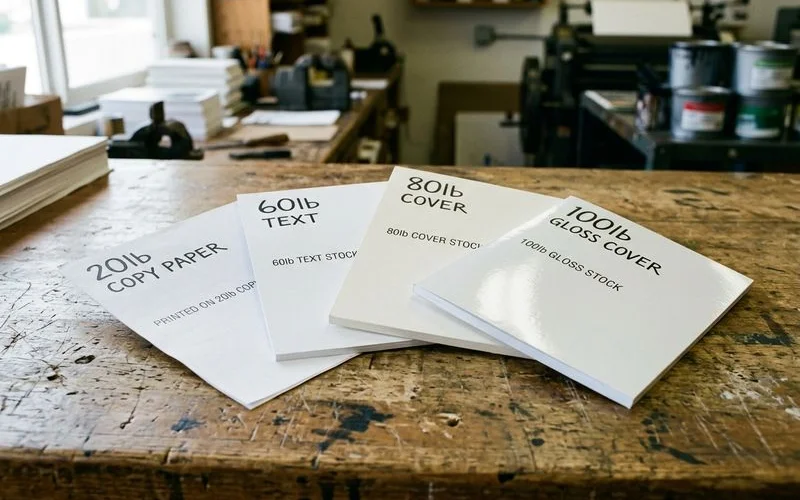
Our highest recommendation for premium collateral is 100 lb. text. A gloss or satin coating on this weight gives photographs a vivid, museum-quality finish. High-end real estate brochures use 100 lb. text to communicate prestige.
Cover Stocks for Premium Durability
Our presses handle cover stock entirely differently than standard text paper. An 80 lb. cover sheet feels like a proper card in your hand. Professional scoring is required before folding this material to prevent the ink from cracking.
Mailing Fact: The United States Postal Service requires postcards to be at least 0.007 inches thick for standard rates. An 80 lb. cover stock typically hits 0.009 inches, making it perfectly compliant for direct mail marketing.
We always remind clients to leverage this thick stock for high-impact door hangers. Local canvassing campaigns rely on this stiff material to stay upright on doorknobs.
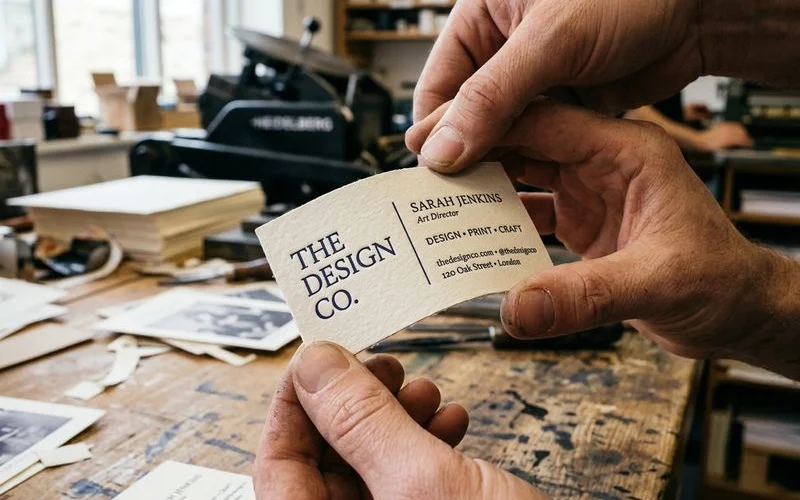
We produce the vast majority of premium business cards on 100 lb. or even 110 lb. cover stock. This heavier material approaches the distinct thickness of a standard playing card. The tangible heft of a 100 lb. cover communicates immediate quality upon first touch.
Coated vs. Uncoated Finishes Explained
Our clients often ask how the surface finish affects their final printed piece. The physical weight is only half the equation. The chemical surface treatment drastically alters how ink sits on the page.
We utilize coated papers to achieve vibrant, highly detailed imagery. A specialized surface treatment reduces ink absorption, allowing colors to dry on top of the sheet.
- Gloss coating: Highly reflective and perfect for bold, contrasting photographs.
- Matte or satin coating: Provides a smooth, non-glare finish that makes text highly readable.
- Soft-touch coating: Adds a velvety, luxurious texture to heavy cover stocks.
Our commercial presses run uncoated paper when the project requires a natural texture or needs to be written on. The raw paper fibers absorb ink deeply into the sheet. This absorption causes a slight softening of colors known as “dot gain” in the commercial printing industry. We source premium uncoated stocks like Neenah Classic Crest to ensure corporate letterheads perform flawlessly. Forest Stewardship Council (FSC) certified uncoated papers remain top choices for eco-friendly branding initiatives.
Quick Reference Guide for Commercial Print Jobs
We built this cheat sheet to streamline your next ordering process. Matching your specific project to the correct stock saves time and prevents expensive reprints. Every successful print job starts with proper material planning.
| Print Job | Recommended Paper Weight | Professional Detail |
|---|---|---|
| Internal Office Forms | 20-24 lb. bond | Highly economical, prone to show-through |
| Standard Marketing Flyers | 60-80 lb. text | Folds cleanly without pre-scoring |
| High-End Catalogs | 100 lb. text | Provides optimal color vibrancy |
| Direct Mail Postcards | 80-100 lb. cover | Meets USPS minimum thickness regulations |
| Premium Business Cards | 100-110 lb. cover | Conveys immediate quality and authority |
| Presentation Folders | 100 lb. cover | Withstands repeated handling and pocket insertion |
Get Professional Guidance Before Printing
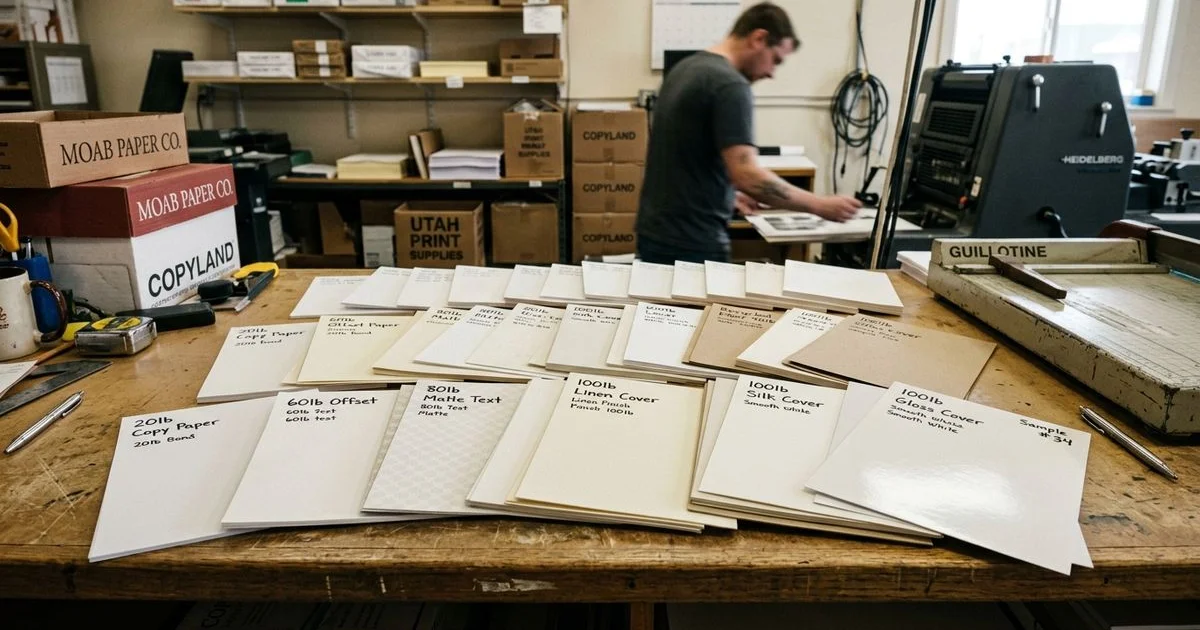
We encourage you to request physical samples if you remain unsure about your material choices. Feeling the actual thickness of a 60 lb. text versus an 80 lb. cover provides absolute clarity. Most standard commercial projects can be test-printed on two or three different stocks for a direct comparison.
Our production specialists are ready to calculate exact costs and recommend the ideal finishes for your campaign. You can easily browse our Color Copies service to view available paper varieties. Taking a moment to request a quote guarantees your project starts on the right track.
We promise that Choosing the Right Paper Weight for Your Print Job ensures your final product looks exactly as brilliant as your digital design.
My Color Copies Team
Print Production Specialists
My Color Copies is a Utah-based print team serving both local and out-of-state customers with affordable, fast printing services.
Digital Printing ExpertiseNeed help with your print job?
We are here to help with file prep, paper choices, and pricing.
Request a Quote