What Size Banner Do You Need? A Quick Guide for Events and Businesses
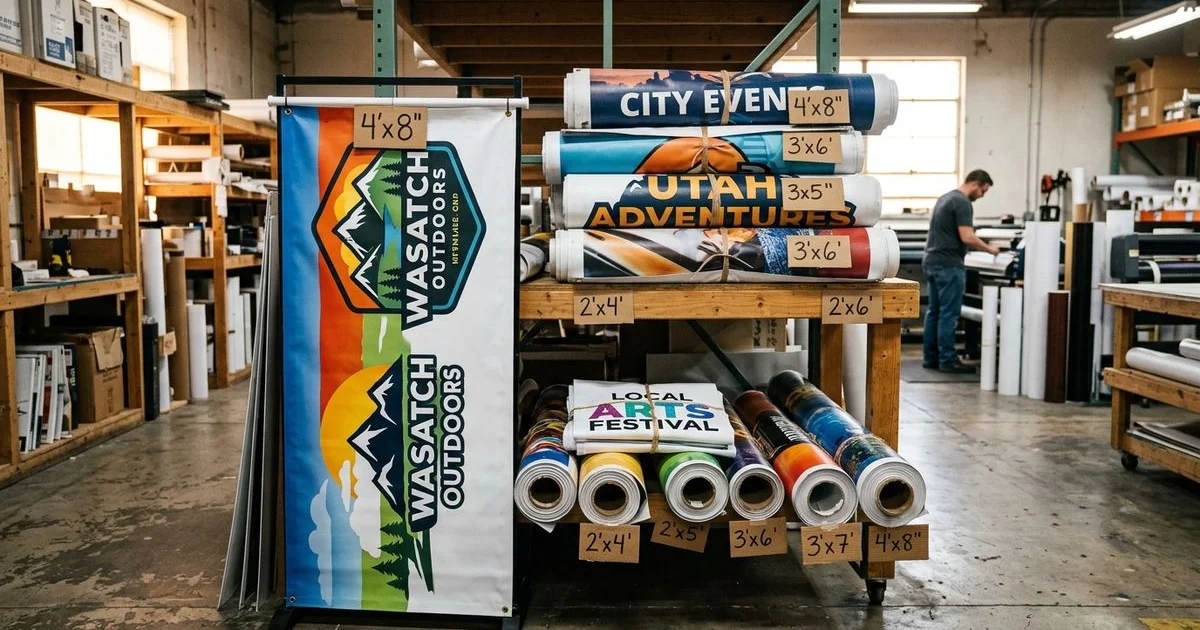
We created this resource because customers constantly ask us, What Size Banner Do You Need? A Quick Guide for Events and Businesses.
A brilliant design loses all its impact if it disappears against a massive exterior wall. Getting the scale right on the first try saves you from expensive rush-printing fees.
Our team has measured and tested these standard sizes across countless US venues.
Let’s walk through the exact specifications you need to make a confident, data-backed choice. This guide breaks down the most reliable industry formats and the formulas required to choose correctly.
The Most Common Banner Sizes and Their Best Uses
We recommend starting your selection process by reviewing the most proven industry dimensions.
Each format serves a very specific purpose in retail environments and trade shows. The list below highlights the standard specifications used by professionals across the country.
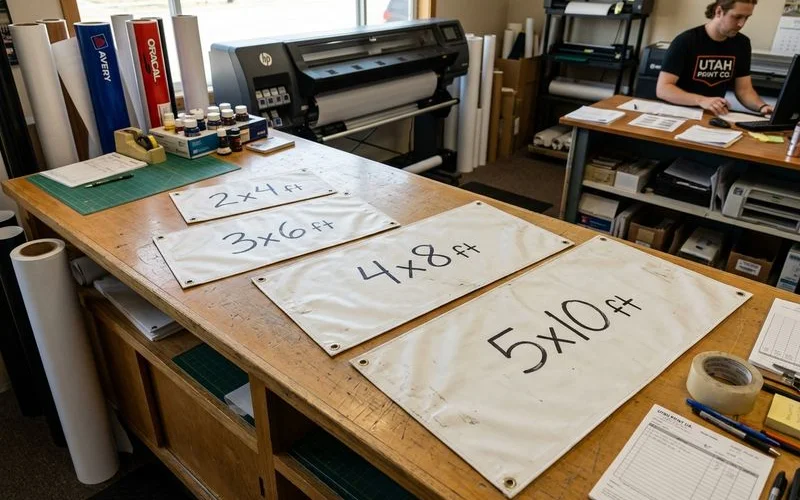
2 ft x 4 ft (2x4) Displays
Our clients frequently use this compact scale for interior spaces and targeted directional signage.
It fits flawlessly across the front of standard folding tables used at local farmers markets. A 2x4 footprint provides just enough room for a crisp logo without cluttering your booth space.
2 ft x 6 ft (2x6) Runners
We find this longer format serves as the ideal table runner for standard presentation setups.
When hung vertically in narrow venue hallways, it creates a highly professional look. The slender profile naturally draws the eye upward in spaces with standard 8-foot US commercial ceilings.
3 ft x 6 ft (3x6) Formats
Our production crew prints more banners in this specific dimension than almost any other size.
It offers enough height to remain visible across a crowded gymnasium. These dimensions remain compact enough to easily transport in the trunk of a standard sedan.
4 ft x 8 ft (4x8) Banners
We always suggest this substantial size for outdoor fences at sporting events and local festivals.
At four feet tall, you can print lettering large enough to be easily readable from 50 to 100 feet away. This format acts as a powerful billboard to stop traffic passing by a retail storefront. For smaller displays, consider poster printing as a cost-effective alternative.
5 ft x 10 ft or Larger Over-Sized Banners
Our installation experts reserve these massive dimensions for building wraps and prominent stage backdrops.
Large-scale advertising requires specialized hardware like heavy-duty bungee cords and reinforced grommets. Wind resistance becomes a serious factor when dealing with fifty square feet of vinyl material outdoors.
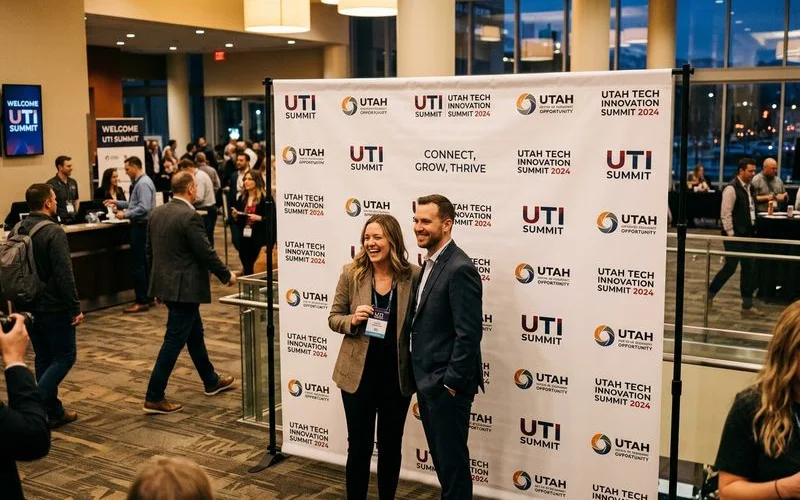
Step and Repeat Event Backdrops
We typically provide 8x8 or 8x10 backdrops for corporate galas and formal press events.
A standard 8x8 frame comfortably accommodates one or two people in a single photograph. Upgrading to an 8x10 backdrop provides ample room to photograph groups of four to six attendees.
How to Choose the Right Size for Your Situation
Our project managers encourage every client to answer a few critical questions before finalizing an order.
Guessing the appropriate dimensions almost always leads to disappointing results on event day. The following considerations will help you reverse-engineer the exact measurements required for your project.
How far away will people be when they read it?
We rely on the United States Sign Council (USSC) legibility index to calculate exact letter heights.
While the baseline USSC index suggests one inch of height per 30 feet, the standard industry rule for comfortable readability is one inch per 10 feet of distance. If your audience stands 30 feet away, your primary text should be at least three inches tall for optimal impact.
Our designers always factor in this readability index before finalizing any layout.
Text meant for passing highway traffic needs to be substantially larger than text aimed at pedestrians. Understanding your viewer reaction distance guarantees your message actually gets read.
Where exactly is the display going?
We strongly advise taking physical measurements of your target location with a reliable tape measure.
Knowing the exact width between two structural poles prevents you from ordering a banner that droops. A chain-link fence with only three feet of vertical clearance strictly limits your maximum height.
Our field teams frequently discover that standard mounting locations vary wildly in actual size.
Leaving a few inches of extra margin ensures your display fits perfectly within a defined frame. Precise location data eliminates the stressful guesswork of installation day.
How much content does the graphic need to hold?
We constantly remind clients that simple, bold messages perform significantly better than paragraphs of text.
A promotional graphic shouting “GRAND OPENING” commands attention even on a relatively narrow piece of vinyl. Menus and complex event schedules demand more surface area to prevent the text from looking cramped.
Our golden rule is that less content printed in larger fonts always beats more content printed in tiny type.
Crowded designs force the reader to squint, which immediately decreases engagement. Prioritize your single most important message to maximize visual impact.
Is the location indoors or outdoors?
We approach outdoor projects very differently because they must compete with buildings, traffic, and visual noise.
Exterior signage generally needs to be larger to stand out against the vast openness of the sky. A controlled indoor environment allows you to utilize smaller, more detailed graphics effectively.
Our team has seen perfectly good 3x6 designs get completely lost at large outdoor fall festivals.
Always scale up your dimensions when preparing for an open-air venue. Weather conditions also dictate the type of reinforced finishing required for longevity.
How is it being hung or displayed?
We match every banner with the appropriate hanging hardware to guarantee a secure installation.
Lightweight indoor displays easily attach to walls using simple tacks or double-sided adhesive tape. Heavy-duty outdoor applications require reinforced grommets paired with flexible bungee cords to absorb wind energy.
Our production facility can add specialized pole pockets for massive frame systems if you specify your hanging method during ordering.
Informing your printer about the final destination ensures they apply the correct finishing techniques. Proper hardware prevents structural failures during unexpected weather events.
| Viewing Distance | Minimum Letter Height (USSC Baseline) | Recommended Height (Comfortable Reading) |
|---|---|---|
| 30 feet | 1 inch | 3 inches |
| 50 feet | 1.7 inches | 5 inches |
| 100 feet | 3.3 inches | 10 inches |
Orientation: Horizontal vs. Vertical
We process horizontal landscape banners for the vast majority of our standard commercial orders.
This wide format naturally suits building facades and typical mounting situations found in retail environments. Portrait orientation displays, commonly known as feather or pull-up banners, provide a specialized solution for specific contexts.
- Trade show booths, where floor space is limited
- Flanking a stage or entryway
- Window displays
- Indoor retail environments
We highly recommend standard US retractable banner stands for professionals who travel frequently for presentations.
The most common US size for these pull-up displays is 33 inches wide by 80 inches tall. This specific footprint fits perfectly inside a standard 10x10 US trade show booth without dominating the space.
Our premium retractable options include a lightweight carrying case that easily fits into an airplane overhead bin.
If rapid setup and ongoing reuse matter to your business, a roll-up model is an excellent investment. You can simply retract the graphic into its aluminum base for secure transport between events.
Design Tips for Any Banner Size
We have compiled a few fundamental design principles that apply regardless of your chosen dimensions.
A compelling layout ensures your physical display actually generates a return on investment. Implementing these best practices will elevate your artwork from amateur to professional.
Keep the Message Short
We advise clients that a passing driver scans a roadside display in less than three seconds.
Focus entirely on the single most critical detail, such as a business name, an event date, or a discount offer. Extraneous information clutters the visual field and dilutes your primary marketing message.
Use High Contrast Colors
Our print operators prioritize dark text on a light background for maximum visual punch.
Placing light text over a dark backdrop also creates excellent readability from a significant distance. Similar tones blend together under bright sunlight, making the wording entirely unreadable to your audience.
Build Your File at Full Size
We require artwork files to be constructed at 100% of the final print dimensions at a resolution of 100 to 150 DPI.
Setting your software to 300 DPI is completely unnecessary for large-scale formats and results in unmanageable file sizes. Standard vector file types like EPS or Adobe Illustrator AI guarantee crisp, scalable graphics without pixelation.
Leave Margin from the Edges
Our fabrication team needs at least two to three inches of empty space around the perimeter of your design.
This critical safe zone ensures essential logos are not accidentally punched through during the grommeting process. Adequate margin also allows room for heavy-duty hemming without compromising your beautiful typography.
Wrapping Up: What Size Banner Do You Need? A Quick Guide for Events and Businesses
We make the entire ordering process seamless once you have answered the question, What Size Banner Do You Need? A Quick Guide for Events and Businesses.
Check out our comprehensive Banners page for detailed material specifications and hardware options.
Feel free to request a quote today with your preferred size, required quantity, and specific event details!
My Color Copies Team
Print Production Specialists
My Color Copies is a Utah-based print team serving both local and out-of-state customers with affordable, fast printing services.
Digital Printing ExpertiseNeed help with your print job?
We are here to help with file prep, paper choices, and pricing.
Request a Quote